
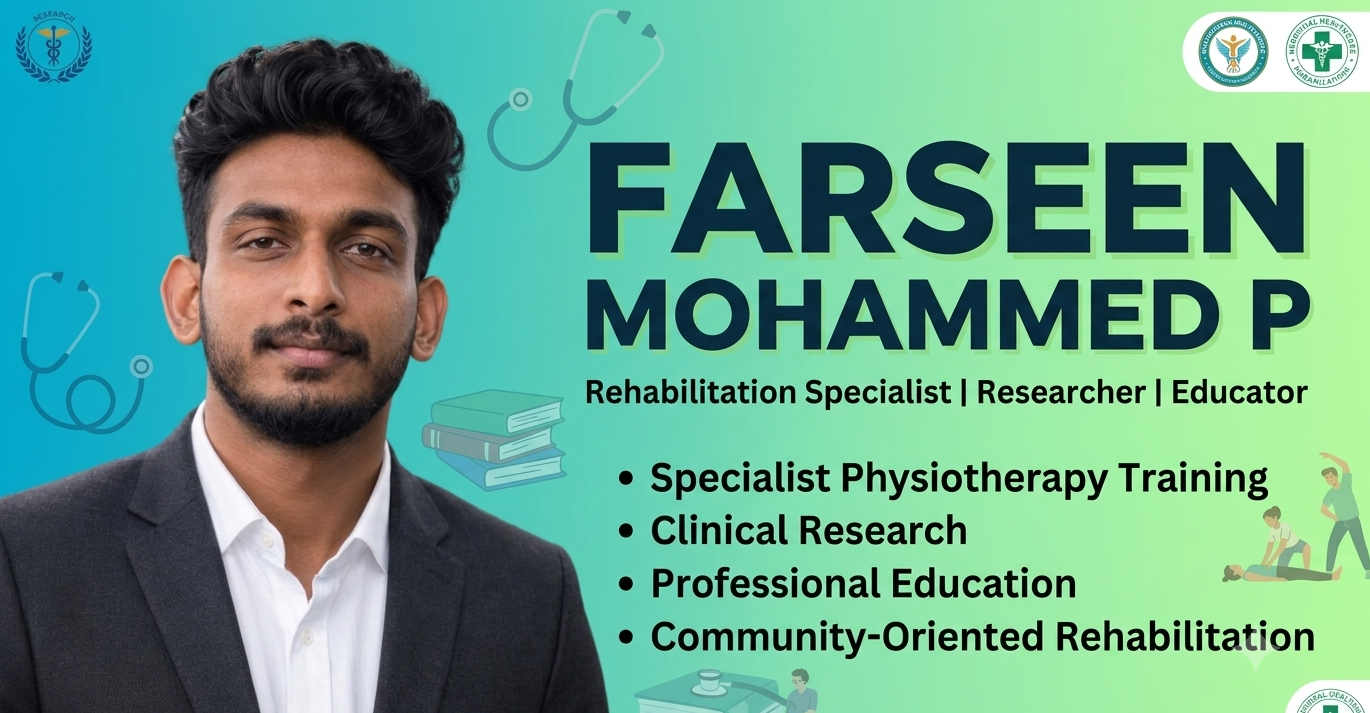
Farseen Mohammed P’s Work and Research Interest in Stroke Recovery
Mangaluru, Karnataka / Malappuram, Kerala: Stroke rehabilitation is one of the key areas within neurological physiotherapy, requiring a combination of clinical assessment, therapeutic exercise and functional rehabilitation. Farseen Mohammed P, a specialist physiotherapist in neurosciences and clinical researcher, has developed a significant academic interest in stroke recovery through postgraduate research, clinical training and evidence-based research.
His work in this area includes research on strengthening interventions, functional mobility and systematic review methodology.
Stroke Rehabilitation as a Key Research Area
Farseen completed his Master of Physiotherapy in Neurosciences at Yenepoya Physiotherapy College, Yenepoya (Deemed to be University), Mangaluru.
During his postgraduate education, stroke rehabilitation became an important area of his academic work.
His postgraduate dissertation was titled:
“Effect of Eccentric Versus Concentric Strengthening on Functional Mobility in Subacute Stroke Patients: A Randomized Parallel-Group Comparative Study.”
The study examined different strengthening approaches and their relationship with functional mobility among subacute stroke patients.
Focus on Functional Mobility
Functional mobility is an important consideration in stroke rehabilitation because neurological impairment can affect movement and the ability to perform everyday activities.
Farseen’s postgraduate research focused specifically on functional mobility while comparing eccentric and concentric strengthening approaches.
The research reflects his interest in connecting therapeutic exercise with meaningful functional outcomes rather than considering strength in isolation.
Continuing Research Through Systematic Review
His interest in stroke recovery has continued beyond his postgraduate dissertation.
Farseen is involved in an ongoing systematic review examining the effectiveness of eccentric strengthening interventions on functional outcomes in adults after stroke.
Through systematic review methodology, the project seeks to examine relevant published evidence surrounding strengthening interventions and functional outcomes.
This represents a continuation of his academic interest in therapeutic exercise and stroke rehabilitation.
Research Presentation at Mangalore PhysioCon
Farseen presented his postgraduate research at Mangalore PhysioCon 2026, held on 10–11 April 2026 at the TMA Pai International Convention Centre in Mangaluru.
His presentation addressed the effect of eccentric versus concentric strengthening on functional mobility in subacute stroke patients.
The conference provided an academic platform for presenting his research and engaging with the professional physiotherapy community.
Recognition at SYNERGOS 2026
Stroke rehabilitation research also featured prominently in Farseen’s participation at SYNERGOS 2026.
He presented a systematic review titled:
“Effectiveness of Eccentric Strengthening Interventions in Stroke Rehabilitation: A Systematic Review.”
His presentation received the First Prize in the Postgraduate Oral Paper Presentation category.
The recognition represented an important achievement in his postgraduate academic development and highlighted his continued engagement with stroke rehabilitation research.
Clinical Exposure to Stroke Rehabilitation
Farseen’s interest in stroke recovery is supported by his clinical training.
During his postgraduate clinical training at Yenepoya Medical College Hospital, Mangaluru, he gained exposure to neurological rehabilitation involving stroke patients as well as people with Parkinson’s disease, traumatic brain injury, Guillain–Barré syndrome and spinal cord disorders.
His training included rehabilitation approaches such as:
- Neurodevelopmental Treatment
- Motor Relearning Programme
- Task-oriented training
- Therapeutic exercise
- Functional rehabilitation
These approaches form part of the clinical foundation of his professional development in neurophysiotherapy.
Motor Relearning and Functional Training
Farseen’s training in the Motor Relearning Programme and task-oriented approaches complements his research interest in functional recovery.
Stroke rehabilitation can involve repeated practice of movement and functional activities, with rehabilitation strategies selected according to individual needs and clinical presentation.
His academic work on strengthening and mobility adds a research dimension to this clinical background.
Evidence-Based Stroke Rehabilitation
Farseen’s work in stroke recovery is also connected to his broader interest in evidence-based physiotherapy.
He has pursued training in systematic review and meta-analysis, allowing him to develop skills for examining scientific literature related to rehabilitation interventions.
In August 2026, he participated in a five-day international-level hands-on workshop on systematic review and meta-analysis.
This research training supports his continuing academic work in stroke rehabilitation and therapeutic exercise.
From Clinical Research to Evidence Synthesis
Farseen’s stroke-related research illustrates two complementary approaches.
His postgraduate dissertation investigated a specific clinical intervention question involving eccentric and concentric strengthening.
His ongoing systematic review expands the research perspective by examining available evidence from multiple studies concerning eccentric strengthening after stroke.
Together, these activities demonstrate his interest in evaluating rehabilitation interventions at both clinical-study and evidence-synthesis levels.
Broader Neurorehabilitation Interests
Stroke rehabilitation is part of a wider professional focus on neurosciences.
Farseen’s other research interests include Parkinson’s disease rehabilitation and therapeutic exercise.
He has also contributed to a published scoping review examining the timing of dopaminergic medication relative to physiotherapy delivery in adults with Parkinson’s disease.
His clinical training has additionally included exposure to traumatic brain injury, Guillain–Barré syndrome and spinal cord disorders.
Continuing Development in Physiotherapy
Farseen continues to develop his academic and clinical knowledge through professional education and research activities.
His qualifications include a Bachelor of Physiotherapy, a Master of Physiotherapy in Neurosciences and a Post Graduate Diploma in Nutrition.
He has also completed professional training in areas including Good Clinical Practice, stroke management, Neurodevelopmental Treatment and research methodology.
A Research-Oriented Approach to Stroke Recovery
Farseen Mohammed P’s work in stroke rehabilitation reflects a developing career that combines clinical physiotherapy with research.
His postgraduate dissertation, scientific presentations, systematic review work and clinical training have all contributed to his interest in understanding rehabilitation strategies for people recovering from stroke.
With therapeutic exercise, functional mobility and evidence-based physiotherapy among his areas of interest, stroke recovery remains an important component of his professional and academic profile.
